

If you’ve opened your water bill lately, imagined the future, and groaned, you aren’t alone. Aquarion Water Company (owned by energy giant Eversource) is currently pushing for a staggering 42% rate increase starting in late 2026.
Furthermore, state regulators recently blocked Eversource’s attempt to dump Aquarion onto the Regional Water Authority for $2.4 billion, leaving the utility’s future control and decision-makers in limbo.
This has triggered a quiet, persistent question in District 11 and beyond: Why are we letting outsiders or bureaucrats dictate the price of our most essential resource? Should the Town of Greenwich just buy the system (including the Putnam Lake facility on DeKraft Road in District 11)?
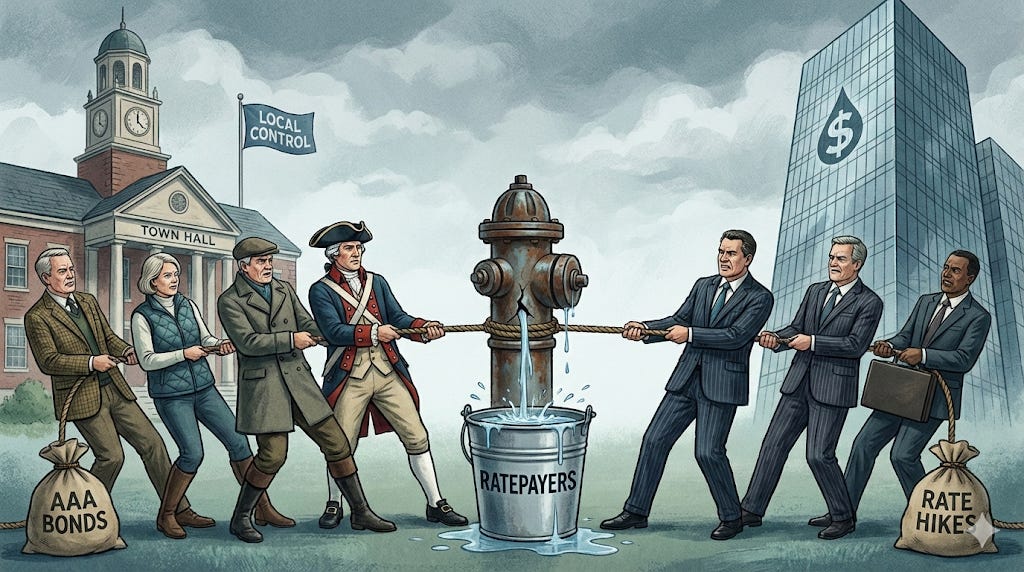
It’s a seductive idea. “Municipal Water.” Local control. No corporate profits. That’s how it works for 85-90% of USA households.
But before we grab the pitchforks (or garden hoses), what do the numbers on what a hostile takeover of the Greenwich water system actually look like? It is complicated, expensive, and fraught with political landmines.
The Price Tag: A Cool Quarter-Billion
How do you price a water system? You can’t just Zillow the Putnam Water Treatment Plant.
Based on the recent valuations in the failed sale of Aquarion’s total Connecticut assets, experts value these utilities at roughly 1.7 times their infrastructure “base.”
Greenwich represents about 10-12% of Aquarion’s customer base, but our assets (reservoirs, premium treatment plants) are high-value, and our consumption is high.
The Estimated Fair Market Value: $250 Million to $350 Million.
That is the starting line for negotiations. Eversource would fight tooth and nail for the higher end.
The Case FOR Buying: Taking Back Control
If the Town can stomach the sticker price, the arguments for municipal ownership are compelling, centering on long-term savings and sovereignty.
1. Immunity from Wall Street “Return on Equity” This is the big one. Every time Aquarion raises rates, a chunk of that money goes to ensuring a 9-10% profit margin for Eversource shareholders. A municipal utility doesn’t need profit; it just needs to break even. Theoretically, rates would only rise to cover actual pipe repairs and operations, permanently flattening the curve of your water bill.
2. The “AAA” Advantage Private corporations borrow money at higher corporate interest rates. Greenwich has a sterling AAA bond rating. We can borrow money dirt cheap (3-4% municipal bonds). Over 30 years of financing hundreds of millions in infrastructure upgrades, that difference in interest rates saves local ratepayers tens of millions of dollars.
3. Tax-Free Operations The Town does not pay federal income tax on revenue, nor does it pay sales tax on materials bought for upgrades. That is an immediate 20-30% operational savings that can be reinvested directly into aging pipes instead of fed to the IRS.
The Case AGAINST Buying: The Financial Sinkhole
The arguments against buying the system are rooted in political reality and fear of debt.
1. The “Hidden” Tax Increase This is the argument that usually kills municipalization talk dead.
Right now, Aquarion is a private company. They are likely one of the top 5 property taxpayers in Greenwich. They pay the Town millions annually in real estate and personal property taxes on their pipes, plants, and land.
If Greenwich buys the system, that property becomes government-owned and therefore tax-exempt.
Overnight, millions of dollars vanish from the Town’s General Fund revenue. To fill that sudden hole, the BET would have to immediately raise property taxes on every single resident. You might save on your water bill, but your mill rate would go up to compensate.
2. Double the Debt Greenwich prides itself on low debt, usually operating on a modified “pay-as-you-go” model. Issuing $300 million in bonds to buy a utility would nearly double the Town’s debt load overnight. This could threaten that precious AAA rating and crowd out funding for other crises, like school renovations or flood remediation.
3. The “Competence Crisis” The RTM has recently hammered the administration for lacking coherent long-term capital planning for the assets we already own (schools, rinks, drainage).
Do we really want to add a complex, EPA-regulated chemical treatment and distribution system to the Town’s portfolio? Running a water system requires specialized engineers and 24/7 emergency crews. Greenwich would likely have to hire a private firm to run it anyway—meaning we pay the $300M purchase price but fail to eliminate the management fees.
The Bottom Line for District 11
The idea of kicking corporate interests out of our water supply feels good emotionally. But financially, it’s a high-stakes gamble involving massive debt issuance and the paradox of losing tax revenue to gain asset control.
If this idea is proposed, the critical question to ask the Selectmen and BET is simple:
“How many millions in property tax revenue do we currently collect from Aquarion annually, and exactly how much will my property taxes have to rise to replace that money if we take them over?” This impacts all residents and taxpayers in addition to the long-term borrowing that’d be needed for the acquisition.
Therefore, in all likelihood the proposed transaction is probably the lowest cost to residents path ahead (despite the significant rate hikes expected over the next decade).